-3.png)
Women Are Reshaping New England Oyster Farming in Shucking Tradition, Coming to NewCinema/Docs+
David Helfer Wells’ award-winning documentary short Shucking Tradition will be streaming on Whush as part of the NewCinema/Docs+ showcase.
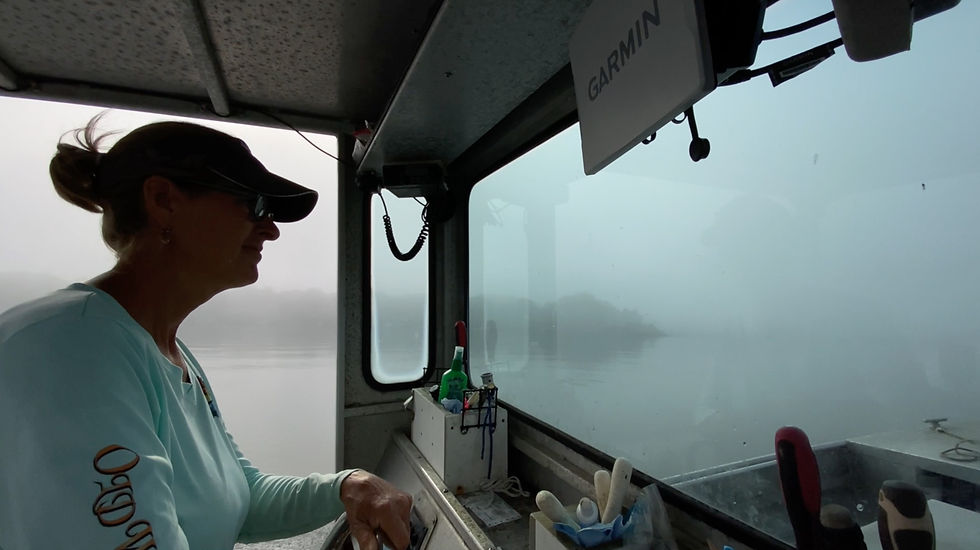
Filmed in coastal New England, the 18-minute documentary looks at a growing number of women working in oyster farming — an industry with centuries of history and a workforce traditionally dominated by men.
Rather than approaching the subject simply as a story about gender, Shucking Tradition is also an introduction to oyster farming itself. Through a series of character studies, Wells examines the people behind the industry while giving audiences an insight into the art, science and physical labour involved in bringing oysters from coastal waters to the table.
At the centre of the documentary are women who are changing the make-up of the industry without necessarily setting out to make a statement about doing so.
For Wells, that distinction was important.
“These women weren't asking for recognition,” he says. “They were proving, day in, day out, that flexibility and work ethic matter more than raw physical strength.”
A Changing New England Industry
Oyster farming has deep roots in New England's coastal communities, where commercial fishing and aquaculture remain closely connected to both local economies and regional identity.
Shucking Tradition examines what happens as a new generation of workers enters that established culture.
The women featured in the documentary largely avoid defining themselves through their gender.
Instead, Wells focuses on the work they perform and the practical skills required to succeed in an occupation that can be physically demanding, repetitive and largely invisible to the consumers who eventually encounter the finished product.
The director sees the women in the film not as unusual exceptions but as evidence of a broader change taking place within the industry.
That perspective also informed how Wells chose to film them. In his director's statement, he describes an approach based on patience and restraint, deliberately avoiding over-explaining the subject or turning the women into symbols for a larger argument.
The result is intended to work on two levels: as a portrait of the farmers themselves and as an accessible introduction to an industry that many viewers may know very little about.

The Art, Science and Labour Behind an Oyster
One of Wells' main objectives with Shucking Tradition was to show audiences what oyster farming actually involves.
The documentary presents the work as a combination of art, science and labour, giving outsiders a clearer understanding of an industry whose processes are largely hidden by the time seafood reaches a restaurant or dinner table.
“I hope viewers come away with a real sense of what oyster farming actually involves,” Wells says. “But more than that, I want people to see these women as they are: not exceptional outliers, but the visible edge of a bigger shift in the industry.”
Questions surrounding labour are therefore an important part of the film. Wells is interested not only in who performs difficult work, but also in how that work is recognised and valued.
That interest is closely connected to his background as a photojournalist.

From Photojournalism to Documentary
Wells has spent decades documenting working-class communities, initially through still photography and, more recently, through documentary filmmaking.
Growing up in California, he developed an early connection with the ocean and coastal communities. For the past 26 years he has lived in Rhode Island, where he developed a particular interest in the state's commercial fishing industry.
His career as a photojournalist has included work for publications such as the Los Angeles Times, Fort Worth Star-Telegram and New York Newsday, as well as Fortune, Life, National Geographic, Newsweek, The Sunday New York Timesand Time.
Over the past decade, Wells has increasingly moved into short-form filmmaking, including work for some of the same publications. Yankee magazine and Greenpeace have also commissioned him to document fishermen and the challenges facing their communities.
That background helps explain the observational approach of Shucking Tradition. Wells says oyster farming had repeatedly attracted his attention because of its history and its connection to the kind of working communities he has documented throughout his career.
What ultimately gave him the film's focus was seeing women entering this tradition-bound industry and establishing themselves primarily through the quality of their work.

An Award-Winning Festival Run
Shucking Tradition has already developed an extensive international festival record, with screenings and recognition across the United States and internationally.
The film won Best Documentary Short at The Women’s Film Festival in Philadelphia and Best Documentary Short at the Women’s Independent Film & TV Festival in Boston in 2025.
In 2026, it received Best Documentary Short at the Sixth Borough Film Festival in New York.
The documentary has also been selected for festivals including Independent Film Festival Boston, Ocean City Film Festival, Atlanta Women’s Film Festival, Dana Point Film Festival, Block Island Film Festival, Harrogate Film Festival in England, AmiCorti International Film Festival in Italy and Stockholm City Film Festival in Sweden.
Further recognition includes an Honourable Mention at Sustain Film Festival in the UK, finalist status at the Guernsey Film Festival and Round Reel International Film Festival, and a nomination at the South Pacific Film Festival in New Zealand.
Coming to NewCinema/Docs+
Its arrival on NewCinema/Docs+ will now make Shucking Tradition available to Whush audiences worldwide.
While the changing role of women in oyster farming provides the film with its central story, Wells is equally interested in documenting the profession itself and the people whose labour sustains it.
That makes Shucking Tradition both a portrait of an industry in transition and a practical look at work that most consumers rarely see.
By keeping its attention on the farmers rather than turning them into symbols, the documentary presents that change largely as it is happening: women arriving at the docks, doing the work and becoming an increasingly visible part of a longstanding New England tradition.
Shucking Tradition (United States, 2024–2025), directed by David Helfer Wells, runs 18 minutes 23 seconds and will stream worldwide on Whush as part of the NewCinema/Docs+ showcase.


Comments